

 Written by Adrian Zmudzinskistaff writerEdited by Bryan O'Sheastaff editor
Aave weighs closing 6 V3 blockchain markets, offboarding 50 low-use reserves
Latest NewsPublishedJul 31, 2026
DeFi risk management service LlamaRisk recommended that Aave wind down every reserve on Sonic, Scroll, zkSync, Metis, Soneium and Aptos, but action against most of those instances was already taken.

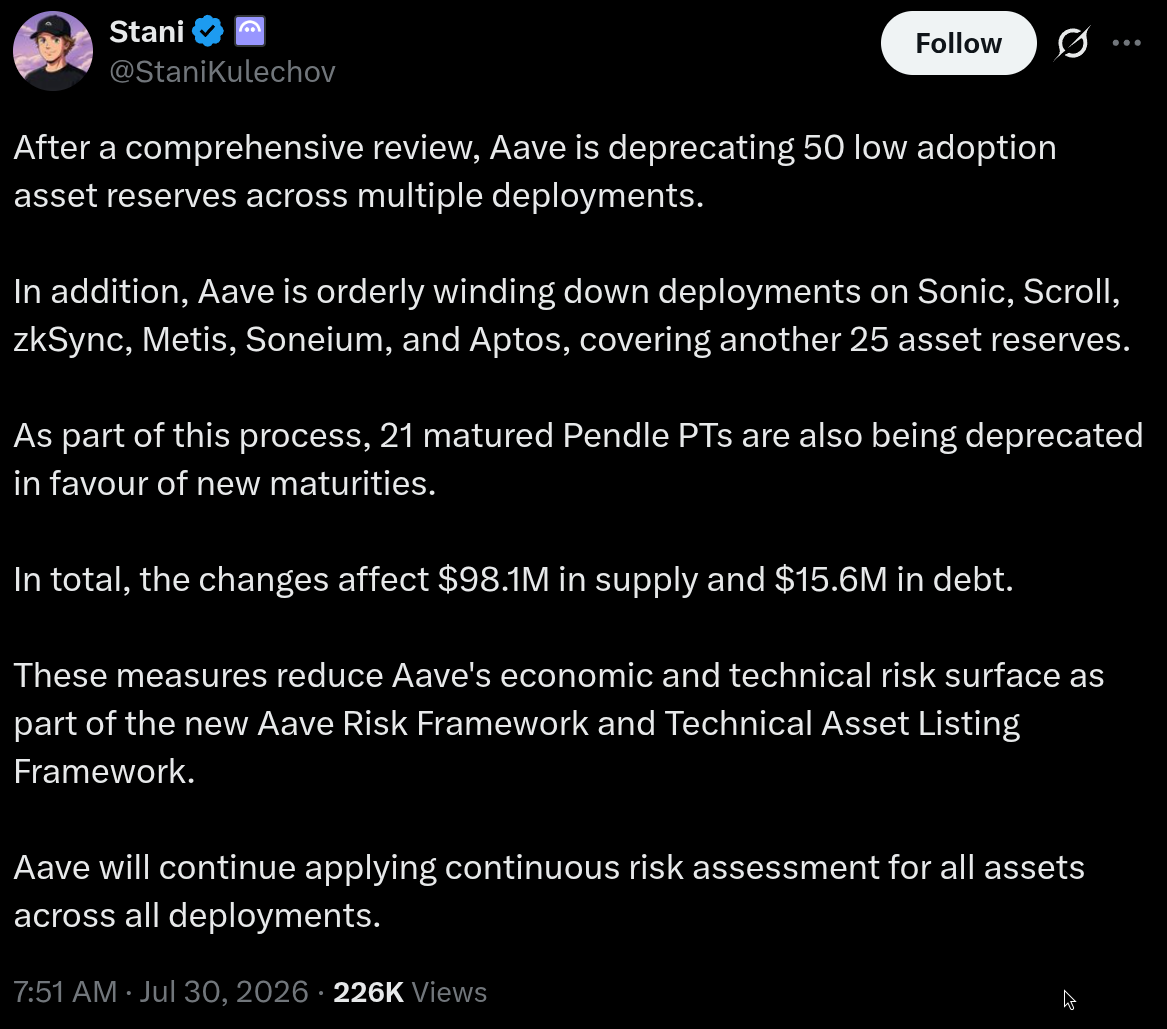
An Aave governance proposal would wind down the lending protocol’s V3 markets on six blockchains and retire dozens of low-use token listings, a cleanup covering $98.1 million in supplied assets and $15.6 million in debt.
Risk service provider LlamaRisk, working with other Aave service providers, recommended offboarding 50 low-use reserves and 21 matured Pendle principal token listings across 11 deployments. It also proposed retiring all 25 reserves on Sonic, Scroll, zkSync, Metis, Soneium and Aptos. The balances were measured on July 28.
An ARFC is a detailed proposal and precursor to an Aave Improvement Proposal; it is not, by itself, proof of a completed final onchain vote or execution.
Aptos exit follows recent launch
The proposed Aptos exit comes just 11 months after Aave launched its V3 market there, with available liquidity down 94% over six months and quarterly revenue below $1,000, according to LlamaRisk.
Every reserve on Scroll, zkSync, Metis and Soneium was already frozen, whereas Sonic and Aptos remained active and are recommended for freezing. The temp check on Aave’s multichain strategy concluded on Dec. 5, 2025, with 923,400 votes in favor and under 1% against increasing the reserve factor on underperforming instances, shutting down the instances on zkSync, Metis and Soneium, and establishing a $2 million annual revenue floor for new instance deployment.
Related: Aave positioned to capture tokenized asset growth in DeFi: Standard Chartered
Scroll was then added to the affected protocols through an accelerated process in April, as LlamaRisk filed a direct-to-AIP proposal to freeze every Scroll reserve and raise selected reserve factors, describing the measure as completing Scroll’s deprecation after a rapid deterioration in network liquidity and Aave market activity. Aave also published an updated risk framework on June 9, covering asset, bridge, monitoring and chain risk and criteria for winding down reserves or deployments, and this month’s announcement indicated de facto adoption of those rules by the protocol.
Source: Stani Kulechov
Aave founder Stani Kulechov said in a Thursday post that this will also “reduce Aave’s economic and technical risk surface as part of the new Aave Risk Framework and Technical Asset Listing Framework.”
Related: Aave brings V3 lending and GHO stablecoin to Monad
Still, this is not a reversal of Aave’s multichain expansion strategy, rather a strategic refocusing on select protocols. “Aave will continue applying continuous risk assessment for all assets across all deployments,” Kulechov said. The comments also follow Aave launching on Avalanche earlier this month.
Magazine: The real reason DeFi projects that survived 2022 crash are shutting down now


Subscribe to daily byte-sized crypto news from Cointelegraph
Cointelegraph is committed to independent, transparent journalism. This news article is produced in accordance with Cointelegraph’s Editorial Policy and aims to provide accurate and timely information. Readers are encouraged to verify information independently.
More on the subject